






Find the Friction That Actually Repeats
Dynamics crm ecommerce integration works best when the first use case is narrow enough to test, specific enough to measure, and close enough to a real pain point that people will actually use it.
A task that consumes five minutes but happens thirty times a day is a more useful starting point than a transformation that would theoretically reshape a whole workflow. The first demonstrates value quickly. The second requires the organization to change more than it is probably ready to change.
Repeated friction is a signal worth taking seriously. For a business whose CRM and ecommerce checkout were set up by different teams, some version of that friction shows up every day. An agent copying an order status from one screen to another. A manager running a weekly export because the two systems do not share the data automatically. A customer repeating their information because the channel they just switched from does not appear in the agent’s view.
None of those examples requires a sophisticated integration to fix quickly. Some of them require a carefully planned integration to fix correctly and sustainably. The difference matters. Starting with the simplest version of the most repeated problem gives the team something to build on and something to validate before scaling.
Look for work that happens frequently and demands attention. That is usually where dynamics crm ecommerce integration returns its first value.
Map What Happens at the Handoff
Customer handoffs are where confidence disappears. When someone submits a request online and calls to follow up, they expect the person who answers to know what they submitted. When that expectation is not met, the experience degrades in a specific and memorable way.
Map the handoff from the customer’s perspective and from the agent’s perspective separately. What does the customer expect after submitting a request? What does the agent actually see? The gap between those two answers is usually the most important design requirement in the whole integration.
For dynamics crm ecommerce integration, missing confirmations and inconsistent status labels often cause more damage than a missing advanced feature. Fixing the handoff experience, specifically the moment when a customer’s expectation and the agent’s information diverge, creates a noticeable improvement in the service experience that neither system could achieve independently.
Trace what the customer expects after the handoff. The gap between expectation and reality is the use case worth solving.
Work Through a Real Service Scenario
A scenario is more useful than a feature list. Take a specific, common service situation and work through what it would require: what triggers the action, what information is available, who can approve something if approval is needed, how completion is confirmed, and what happens if the confirmation does not arrive.
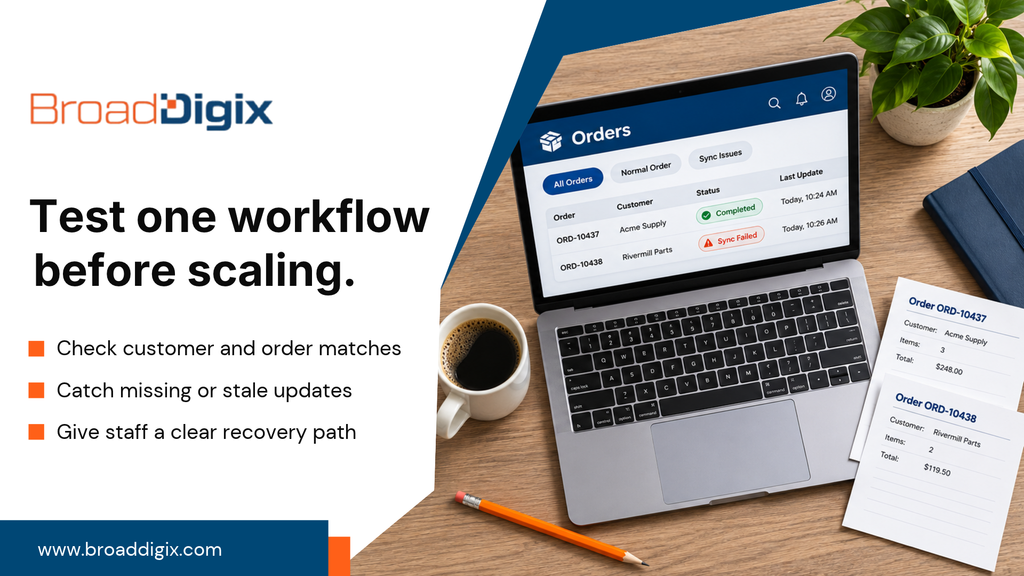
A customer calls to ask about an order that shows as processing in the confirmation email but shows no record in the commerce platform. The agent needs to look up the order, find the commerce record, determine whether the disconnect is a sync delay or a genuine failure, and give the customer an accurate status. Without dynamics crm ecommerce integration, that task requires manual work across two systems. With the integration working correctly, the agent answers from one place in a fraction of the time.
Working through this scenario reveals requirements that a feature list would not. The agent needs to tell the difference between a sync delay and a missing record. The CRM needs to surface the commerce status without requiring a separate login. The failure state needs to be distinguishable from the processing state. Those are design requirements that emerged from tracing one real scenario, not from imagining ideal features.
Ask the People Who Handle Exceptions
The staff who do the work understand its failure modes better than anyone else in the organization. And the failure modes are almost always more common and more varied than the project sponsors are aware of.
Ask what happens on the busiest day of the month. Ask what someone does when a record is wrong or missing. Ask who they contact when an edge case appears that the standard process does not cover.
For dynamics crm ecommerce integration, the exception handling requirements that emerge from these conversations are usually the ones that determine whether the integration is trustworthy in production. A system that handles the happy path well but requires manual intervention for every exception transfers the operational burden rather than reducing it.
The person doing the work knows which exceptions are common. Talk to them before the design is set.
Compare the Simple Version With the Ambitious One
Before committing to a complex use case, compare it with a simpler version that tests the same core assumption.
The simple version might synchronize confirmed order summaries from the commerce platform to the CRM without attempting to handle returns, loyalty program updates, or real-time inventory. The ambitious version does all of that and more. The simple version tests whether the basic identity matching and data transfer works reliably. The ambitious version tests all of that plus several additional assumptions, some of which may turn out to be wrong.
Building the simple version first does not mean building a lesser system. It means building in a sequence that allows the organization to learn before committing to the full scope. For dynamics crm ecommerce integration, this sequence consistently produces better outcomes than the reverse.
The ambition belongs in the vision. The discipline belongs in the delivery sequence.
Make the Example Measurable
A scenario that cannot be measured cannot demonstrate its own value. That matters when the investment needs to be justified, when the next phase needs to be prioritized, and when the team needs to know whether the problem they solved is staying solved.
Establish a baseline before changing anything. How many manual corrections does the current process require per week? How long does it take an agent to answer an order status question? How often do order statuses in the two systems disagree? Those numbers, taken before any changes are made, become the evidence that the integration is working. Microsoft’s official documentation on Dynamics 365 integration capabilities outlines the available connector options in detail.
For dynamics crm ecommerce integration, measuring both the efficiency outcome and the quality outcome prevents a situation where a faster process hides a higher error rate. An apparently improved metric that conceals an increase in downstream corrections has not improved the situation for anyone except the person presenting the headline number.
Without measurement, examples remain useful illustrations of a concept, not proof of a result.
Take the Lesson, Not Just the Pattern
The most useful thing to learn from any use case is a question that travels. Not a specific technical solution or a process that worked in one context. A question about where ownership lives, what information is authoritative, and what happens when something is wrong.
Those questions apply across different use cases, different industries, and different integration architectures. They are more transferable than a specific feature list and more honest about the complexity of the problem.
For dynamics crm ecommerce integration, the useful question from every starting use case is: who owns the resolution when this breaks? That question, answered before the build starts, produces integrations that can be operated and maintained. Asked only after the first incident, it produces a conversation that everyone would rather have avoided.
Frequently Asked Questions
How do you identify the right starting use case for dynamics crm ecommerce integration?
Look for tasks that happen frequently, consume staff attention, and would produce a noticeable improvement if they were faster or more accurate. Repeated manual work that happens because two systems do not share data is a reliable starting point. The right starting use case is usually not the most transformative one. It is specific enough to test a core assumption, small enough to build quickly, and observable enough to measure whether it worked.
What makes customer handoffs a priority use case for a CRM and ecommerce integration?
Handoffs are the moments when customer expectations and agent information most often diverge. A customer who submits a request online and calls to follow up expects the agent to know what they submitted. When that expectation is not met, the service experience degrades in a specific and memorable way. Fixing the handoff experience by giving agents access to relevant commerce information from within the CRM produces an observable improvement in service consistency without requiring the most ambitious integration architecture.
How do you use service scenarios to identify integration requirements?
Take a specific, common service situation and work through it completely: what triggers the action, what information needs to be available, who can approve something if needed, how completion is confirmed, and what the failure state looks like. The practical details that emerge from this exercise surface requirements that a feature list would not. A scenario that reveals the agent needs to distinguish between a sync delay and a missing record has just produced a specific design requirement that the team can build and test.
Why is measuring a baseline important before starting a dynamics crm ecommerce integration project?
A baseline is the evidence that the integration is working. Without a baseline, the team has no basis for knowing whether the problem they solved is staying solved, whether the improvement has held over time, or whether a metric that looks better has concealed a problem elsewhere. The baseline should be established before any changes are made, and it should include both efficiency measures and quality measures so that a faster process that generates more errors is not counted as an improvement.
How should a simple and ambitious use case be compared before committing to a scope?
Describe both versions in terms of what they would require: data access, permissions, exception handling, testing, and ongoing support. Then compare those requirements against what the organization is currently able to build and maintain. If the simple version tests the same core assumption as the ambitious one, start with the simple version. Use the results to build evidence for the next phase rather than committing to the full scope based on optimism about how the complex version will perform.
What lesson should a team take from a completed use case in dynamics crm ecommerce integration?
The most transferable lesson from any completed use case is a question about ownership and decision-making: who owns the resolution when something is wrong, which system’s information is authoritative, and how is a failure surfaced before it reaches the customer? Those questions travel between use cases and across different parts of the integration architecture. A team that has learned to ask them consistently before building produces integrations that behave predictably under conditions the original design did not anticipate.