





The $7 Billion Workaround
How Oracle, Tencent, and Southeast Asia are quietly rewriting the rules of the global AI race without buying a single chip.
It began with a loophole. The United States government spent years building a wall around its most advanced semiconductors and China found a door. That door is now worth $7 billion, and it runs through an Oracle data center somewhere in Southeast Asia.
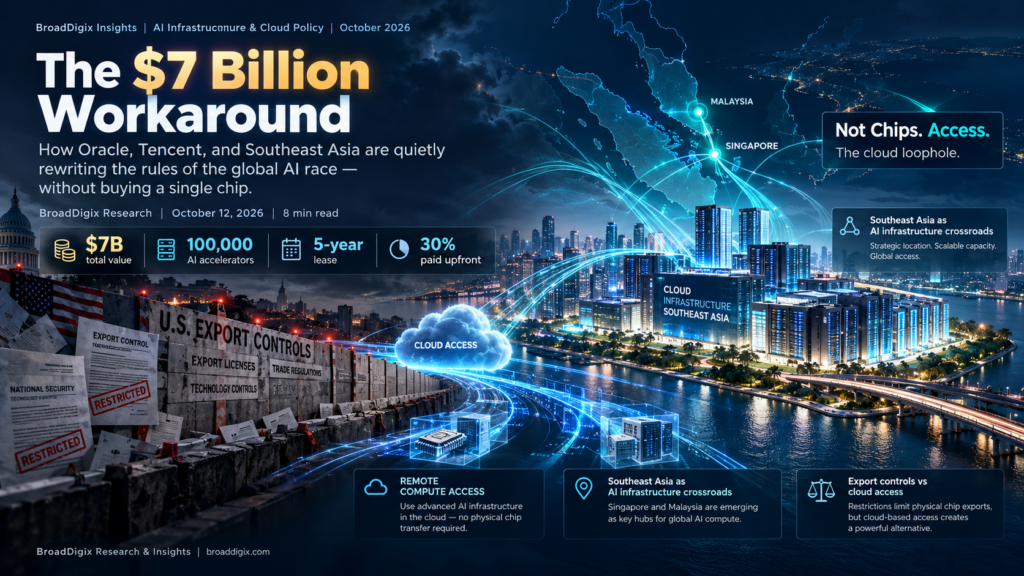
Deal at a Glance: $7B total value | 100,000 AI accelerators | 5-year lease | 30% paid upfront
A Deal That Wasn't Supposed to Be Possible
When the Financial Times broke the story on September 30, 2026, the technology world took notice. Oracle had reportedly agreed to a five-year, $7 billion arrangement granting Tencent China’s social media, gaming, and cloud giant access to approximately 100,000 advanced AI accelerators housed in Oracle data centers across Southeast Asia.
Neither company has officially confirmed the deal. The specific chip models involved remain undisclosed. Yet the financial fingerprints are impossible to ignore: Tencent’s second-quarter 2026 results showed capital expenditure surging 176% year-over-year to RMB 52.8 billion (~$7.9 billion), driving the company to its first negative free cash flow in more than a decade. Tencent CFO John Lo was unusually candid on the earnings call: “Excluding the prepayments for compute procurement, free cash flow would have been approximately RMB 37.6 billion.”
The math lines up almost exactly with a $7 billion compute commitment paid 30% upfront some $2.1 billion in immediate outlay, with the remainder structured over five years.
Key Detail: Under reported deal terms, Tencent pays ~$2.1 billion upfront with the remaining $4.9 billion spread over five years an average of $1.4 billion annually providing Oracle with critical upfront capital to fund the data center buildout that makes the deal possible in the first place.
Not Chips. Access.
This is the sentence that makes the deal remarkable: Tencent is not buying a single chip. It is renting compute time on chips located in a third country, operated by an American company, accessed remotely over a network connection.
Since 2022, the U.S. Commerce Department’s Bureau of Industry and Security (BIS) has progressively tightened restrictions on the export of advanced semiconductors to China most notably Nvidia’s A100, H100, H800, and Blackwell-class accelerators. The January 2026 rules set explicit performance thresholds, capped chip volumes, and introduced mandatory end-use certifications for exports to China. Direct purchase of these chips by Chinese entities is prohibited.
But the word “export” describes a physical transfer of hardware. A cloud customer in Shenzhen using a GPU cluster in Singapore is not importing hardware at least, not under the rules as they were written. This is the cloud loophole: the same computing power, none of the paperwork.
“We can’t let our adversaries especially China dodge our export controls by simply renting what they can’t buy.”
Congressman Josh Gottheimer (D-NJ), co-author of the Cloud Security Act, June 2026
Tencent executives have been direct about the intended use: initial workloads will focus on training larger and more capable AI models, with inference workloads to follow. Excess capacity may eventually be surfaced through Tencent Cloud, potentially making this compute available to developers throughout the Asia-Pacific region.
The AI Machine Tencent Is Building
To understand why Tencent is betting $7 billion on overseas compute, you have to understand what the company is trying to build at home.
For most of 2024 and early 2025, Tencent’s AI position was viewed as behind the curve. Its flagship Hunyuan large language model trailed ByteDance’s Doubao and Alibaba’s Tongyi Qianwen in benchmark performance. The company’s own CEO acknowledged the gap. Then, in late 2025, Tencent restructured its AI team and made a significant hire: Yao Shunyu, a former core researcher at OpenAI, brought on as chief AI scientist to lead Hunyuan development.
The results arrived in 2026. Hunyuan Hy3 launched officially on July 6, 2026, with Tencent reporting a 90% task-completion rate across internal applications a significant jump from prior versions. The model immediately powered Yuanbao, the company’s consumer AI assistant, and developer API fees were sharply reduced to accelerate adoption.
More significant than the model itself is what Tencent is doing with it. The company has begun embedding AI natively into WeChat the “superapp” used by 1.4 billion people globally. A new AI agent called Xiaowei is being tested inside WeChat, built on Hunyuan with DeepSeek handling certain requests. Unlike earlier AI chatbot integrations, Xiaowei is designed to take action booking rides, ordering food, launching mini programs through natural language commands.
This ambition requires serious compute. Training state-of-the-art multimodal models, running inference for 1.4 billion daily active users, and powering real-time agentic tasks simultaneously demands a scale of compute infrastructure that China’s export-restricted domestic supply simply cannot provide at the pace Tencent needs. The Oracle deal is not a workaround it is Tencent’s primary compute strategy.
Oracle's Southeast Asia Gamble
For Oracle, this deal is validation of a years-long infrastructure bet. The company has been systematically building cloud capacity across Southeast Asia: it currently operates two facilities in Singapore and, in October 2024, committed $6.5 billion to establish its first public cloud region in Malaysia one of the largest foreign technology investments the country had ever seen.
Oracle’s cloud infrastructure backlog already stood at $664 billion in remaining performance obligations as of late August 2026. The Tencent deal adds another $4.9 billion in deferred revenue while the upfront $2.1 billion payment directly funds the data center capacity needed to fulfill it.
Markets reacted immediately. Oracle shares climbed nearly 2% in pre-market trading the morning the Financial Times story published. Morgan Stanley, maintaining an Equal Weight rating, nonetheless modeled approximately 50% upside on the stock, citing Oracle’s AI infrastructure expansion as a long-term catalyst.
The strategic logic is straightforward: Southeast Asia offers ample land, relatively favorable regulation, and active government support for digital infrastructure investment. Google, Microsoft, Nvidia, and ByteDance have all made multi-billion dollar commitments to the region in the past 18 months. Oracle is positioning its Southeast Asian footprint as the compute layer for an entire hemisphere of AI demand Chinese-origin demand included.
The Regulatory Fault Line
Washington noticed. The Oracle-Tencent arrangement sits at the center of one of the most significant unresolved questions in technology policy: can the United States effectively control AI capabilities when the hardware never crosses a border?
Regulatory Timeline:
January 2026 House passes bipartisan bill 369–22 broadening export controls to cover remote access to controlled hardware over network connections, including cloud computing services.
January 2026 New BIS rules introduce 25% tariff on AI chip exports to China, alongside volume caps and mandatory end-use certification requirements.
June 1, 2026 BIS weekend guidance closes the “subsidiary loophole,” restricting advanced chip sales to entities headquartered in China even when located outside China’s borders. Notably, the guidance does not require data centers to stop using chips already deployed.
June 26, 2026 Representatives Moolenaar and Gottheimer introduce the Cloud Security Act, requiring cloud providers to flag and report suspicious access patterns by foreign adversaries.
September 30, 2026 Financial Times reports the Oracle-Tencent deal. Neither company confirms.
Legal experts have noted the same structural gap: export controls were built around the concept of physical transfer. A photon of compute delivered over fiber to a server in Singapore is not a chip crossing a border. Congress is now racing to write rules that match how compute actually moves in 2026 but the Oracle-Tencent deal may be consummated, and its data centers operational, before those rules are final.
What This Means for the Industry
Stripped of the geopolitics, the Oracle-Tencent deal signals how the AI infrastructure market is fundamentally maturing. Three shifts are worth tracking.
Compute has become a strategic commodity. Tencent’s willingness to commit $2.1 billion upfront accepting negative free cash flow for the first time in a decade reflects a boardroom judgment that compute capacity is now a strategic resource with long-term structural scarcity.
Southeast Asia is the new neutral zone. Malaysia, Singapore, Indonesia, and the Philippines are emerging as the geopolitically accessible compute layer that sits between Chinese demand and American hardware. Oracle, AWS, Google, and Microsoft are competing to be the infrastructure layer that mediates that access.
The cloud loophole may define U.S. tech policy for the next five years. If the Cloud Security Act advances broadly or if BIS issues guidance treating remote access to controlled chips as a deemed export Oracle faces a choice between its largest-ever cloud contract and compliance with U.S. national security requirements.
The Race Continues, Rules Still Being Written
There is a certain irony in the Oracle-Tencent story. The United States spent years building a regulatory architecture to prevent China from acquiring the compute needed to build transformative AI. Oracle, one of the pillars of American enterprise technology, has apparently found a structure that delivers that compute anyway legally, and at scale.
Whether you view that as ingenious arbitrage or a dangerous loophole depends on which side of the export control debate you stand on. What is not in dispute is the commercial reality: Tencent is getting 100,000 advanced AI accelerators, Oracle is getting a $7 billion contract with $2.1 billion upfront, and Southeast Asia is cementing its role as the world’s AI infrastructure crossroads.
For enterprises building AI strategy today whether in managed services, cloud integration, or AI product development the implications are concrete. The compute that powers the next generation of Chinese AI products may be running on Oracle Cloud infrastructure in Malaysia. Tencent’s WeChat, with 1.4 billion users and an AI agent embedded directly into its interface, is training on chips that neither country technically “sold.” The regulatory perimeter around AI capability is, for the moment, a dotted line.
Washington has noticed. The Cloud Security Act is moving. BIS is tightening. But technology rarely waits for policy and in this particular race, the gap between what is possible and what is permitted may be exactly where the most consequential AI is being built.
Contact Broadigix | broaddigix.com