






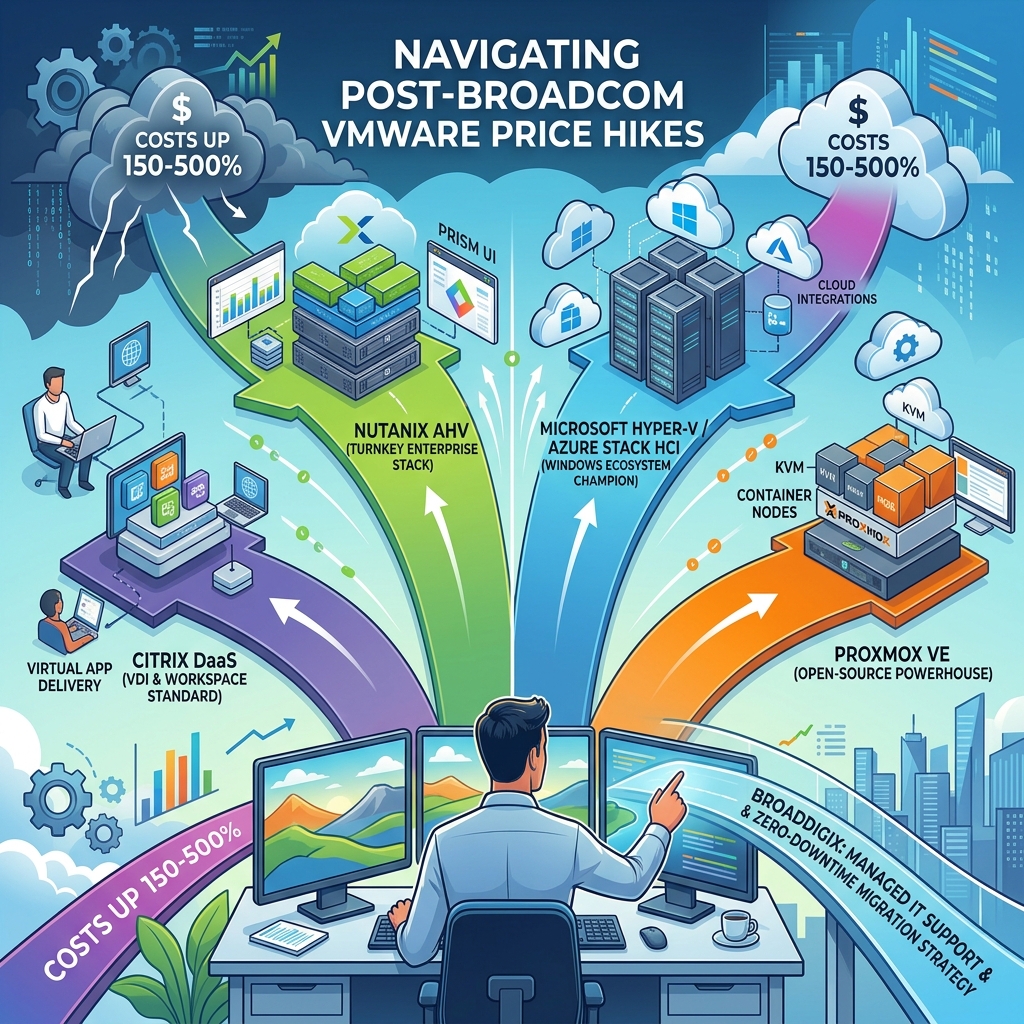
Navigating the Post-Broadcom VMware Price Hikes: Top Virtualization Alternatives for IT Managers
The enterprise virtualization landscape has been thrown into chaos. After Broadcom took over VMware IT managers around the world are facing increases in renewal costs. Some organizations are seeing license price hikes that range from 150% to than 500%.
Broadcom has completely changed the VMware pricing model. Perpetual licenses are gone. Software is now bundled tightly. There are per-core subscription rules with high minimum license requirements.
For IT managers and CIOs who must keep infrastructure budgets tight staying on VMware is no longer a choice. Many are now planning their exit strategy. If you are considering moving virtualized workloads or your virtual desktop infrastructure several strong alternatives are ready to help.
The Top VMware Alternatives for 2026
1. Citrix. Daas (The VDI & Workspace Standard)
For businesses that use VMware Horizon for Virtual Desktop Infrastructure Citrix is the natural and mature step forward.
Why it works: Citrix leads the market in application delivery and digital workspaces. When you use Citrix Hypervisor (XenServer) with Citrix DaaS you get top-tier security, detailed user controls and strong performance for high-density environments. You also avoid the bundle lock-in that comes with Broadcom.
Best for: Application delivery, remote teams and large VDI setups.
2. Nutanix AHV (The Turnkey Enterprise Stack)
If your infrastructure depends on VMware vSAN and Hyperconverged Infrastructure Nutanix AHV is the match in terms of feature set and support.
Why it works: Nutanix includes its KVM-based hypervisor, called AHV built right into its storage platform. The Prism UI makes management simple. You can upgrade with one click. Get disaster recovery built in.
Best for: enterprise data centers that need a direct replacement for VMware.
3. Microsoft Hyper-. Azure Stack HCI (The Microsoft Ecosystem Champion)
For organizations already deep into the Windows environment Microsoft Hyper-V offers an affordable alternative.
Why it works: Hyper-V comes with Windows Server Datacenter licensing so it can be nearly free if you already pay for the OS. For cloud setups Azure Stack HCI works well with your current Microsoft Active Directory, backups and security tools.
Best for: Windows- shops and IT teams with strong Microsoft skills.
4. Proxmox VE (The Open-Source Powerhouse)
Mid-market companies and tech-savvy teams looking to avoid vendor lock-in are turning to Proxmox Virtual Environment. Its adoption has grown fast.
Why it works: Proxmox is source. It combines KVM virtualization with Linux Containers. It has a built-in web interface, backup tools and clustering features without artificial limits or recurring fees.
Best for: IT teams on budgets who want full flexibility and no license penalties.
The Risks of a Rushed Migration
Leaving VMware due to price hikes is smart.. Rushing the move can cause downtime, data loss or broken application connections. A successful shift needs planning. You must look closely at:
- Storage compatibility and how your computing cores are laid out.
- How third-party backup and security tools fit in.
- Training your IT staff on the hypervisor interface.
How BroadDigix Simplifies Your IT Transition
You don’t have to go through licensing changes or complex migrations by yourself. At BroadDigix we offer managed IT support and cloud infrastructure advice to help businesses improve their technology stacks.
Our team will review your VMware setup calculate total cost of ownership for options, like Citrix, Nutanix or Hyper-V and run a smooth zero-downtime migration strategy.